
Table of Contents
- Why Verifying Locksmith Credentials Matters
- How to Check a Locksmith License
- Understanding Locksmith Certification and Professional Qualifications
- Questions to Ask a Locksmith Before Hiring
- How to Find a Reputable Locksmith
- Red Flags: Spotting Credential Fraud and Bait-and-Switch Tactics
- State-by-State Licensing Requirements and Lookup Resources
- Your Verification Checklist Before Work Begins
- Frequently Asked Questions
Last Updated: October 21, 2026
Why Verifying Locksmith Credentials Matters
A locksmith holds the keys to your home, business, or vehicle, access that demands proof, not trust.
Unlicensed locksmiths operate in every market, some inexperienced, others criminals using locksmith work as cover for theft or fraud.
At Finest Locksmith LLC, we’ve seen the damage credential fraud causes.
How to Check a Locksmith License
A locksmith license is your first checkpoint, proof the person met your state’s training and background requirements. Not all states require licensing, but where they do, checking is fast and free.
Search Your State’s Licensing Database
Most states maintain an online database where you can search active locksmith licenses by name or number, the fastest way to verify locksmith credentials. Go to your state’s Department of Consumer Affairs or Professional Licensing Board website, find the “License Lookup” or “Verify a License” tool, and enter the locksmith’s name or license number.
Verify License Status and Expiration
When you find the license record, check three things: status (marked “Active” or “Current”?), expiration date (has it expired?), and restrictions or conditions (any limitations on the work they can perform?). If the license is expired, suspended, or restricted, do not hire that locksmith.
Check for Disciplinary Records and Complaints
A clean license record doesn’t tell the whole story. Many licensing boards keep a separate disciplinary history showing complaints, investigations, and actions taken (warnings, fines, suspension). Look for patterns: one old complaint might be a misunderstanding, but multiple recent complaints suggest a real problem.
Understanding Locksmith Certification and Professional Qualifications
Consumers routinely treat “licensed,” “certified,” and “association-approved” as synonyms. They are not. Each credential is issued by a different body and tests a different thing, so knowing which is which keeps you from accepting a weak credential in place of a strong one.
What Each Credential Actually Proves
| Credential | Issued By | What It Proves | What It Does Not Prove |
|---|---|---|---|
| State locksmith license | State licensing board | The locksmith met the state’s training, background check, and fee requirements and is legally allowed to work | That the work will be done well, or that the price is fair |
| Local permit or business license | City or county | The business is registered and permitted to operate in that jurisdiction | Any locksmith-specific skill or training |
| Professional certification | A trade association or certifying body | The locksmith passed an exam and met experience and continuing-education requirements | That the state recognizes the credential, or that it substitutes for a license |
| Association membership | A trade association | The member agreed to a code of ethics and paid dues | That the member’s work has been independently tested |
| Vehicle-security authorization | Automaker or industry program | The technician is authorized to work on certain vehicle security systems | Residential or commercial locksmith competence |
A license is mandatory where the state requires it. Everything else on that table is voluntary. That distinction matters because a locksmith who leads with a certification while dodging a license question may be doing so because the license does not exist.
Certified Locksmith vs. Licensed Locksmith
A licensed locksmith has cleared the legal baseline in a state that requires licensing. A certified locksmith has completed a voluntary program, documented experience, a written exam, ongoing education. Certification signals professionalism but is not a substitute for a license; in a state that requires one, certification without a license is a compliance problem, not a bonus.
Professional Association Memberships
Trade associations set ethics codes and offer member directories searchable by name or location. Membership shows commitment to the trade but is not an independent test of competence, treat it as a supporting signal, not a primary credential.
Vehicle Locksmith Credentials and Security Access
Automotive locksmith work carries an extra layer: vehicle manufacturers and industry programs authorize technicians to access key and immobilizer systems, separate from a state license. If you’re locked out of a vehicle, ask whether the technician holds the relevant vehicle-security authorization for your make, a residential locksmith with a valid state license may still lack authorization to program a key for a late-model vehicle.
The hierarchy is simple: license first (where required), then insurance and bonding, then certification and association membership as supporting signals. A credential that cannot be verified with the issuing body is not a credential, it is a claim.
Questions to Ask a Locksmith Before Hiring
Before you hand over your address or schedule a visit, ask these questions. A legitimate locksmith answers them directly.
Essential Credential Questions
Ask these questions first:
- “Are you licensed in this state?” (If your state requires licensing)
- “What’s your license number?” (Write it down and verify it immediately)
- “Are you certified by any professional organizations?”
A legitimate locksmith expects these questions. If they get defensive or evasive, that’s a red flag.
Insurance and Bonding Verification
Insurance and bonding protect you if something goes wrong: insurance covers damage the locksmith causes, bonding covers theft or fraud. Ask for proof of liability insurance (email or text a copy) and proof of bonding (bonding company name and policy number), then call the bonding company yourself to confirm the policy is active.
How to Find a Reputable Locksmith
Checking credentials is step one. Finding someone reputable in the first place is step zero.
Verify Business Registration and Identity
A legitimate locksmith operates a real business. Check business registration in your state’s Secretary of State database, whether they have a physical address or just a phone number and website, their local business license number (verify with your city or county), and whether the phone number is local or a national call center.
Check Reviews and Complaint History
Online reviews tell you what customers actually experienced. Check Google, Yelp, Better Business Bureau (BBB) ratings, and local community groups or neighborhood apps.
Look for patterns in negative reviews. One bad review might be a fluke, but multiple mentioning overcharging, damage, or no-shows suggest a real problem.
Red Flags: Spotting Credential Fraud and Bait-and-Switch Tactics
Some locksmiths use deception to get your business. Here’s how to spot it.
Common Fraud Schemes
Watch out for these tactics:
- Fake credentials: The locksmith claims to be licensed but can’t provide a license number or it doesn’t check out
- Bait and switch on price: They quote one price on the phone and charge triple when they arrive
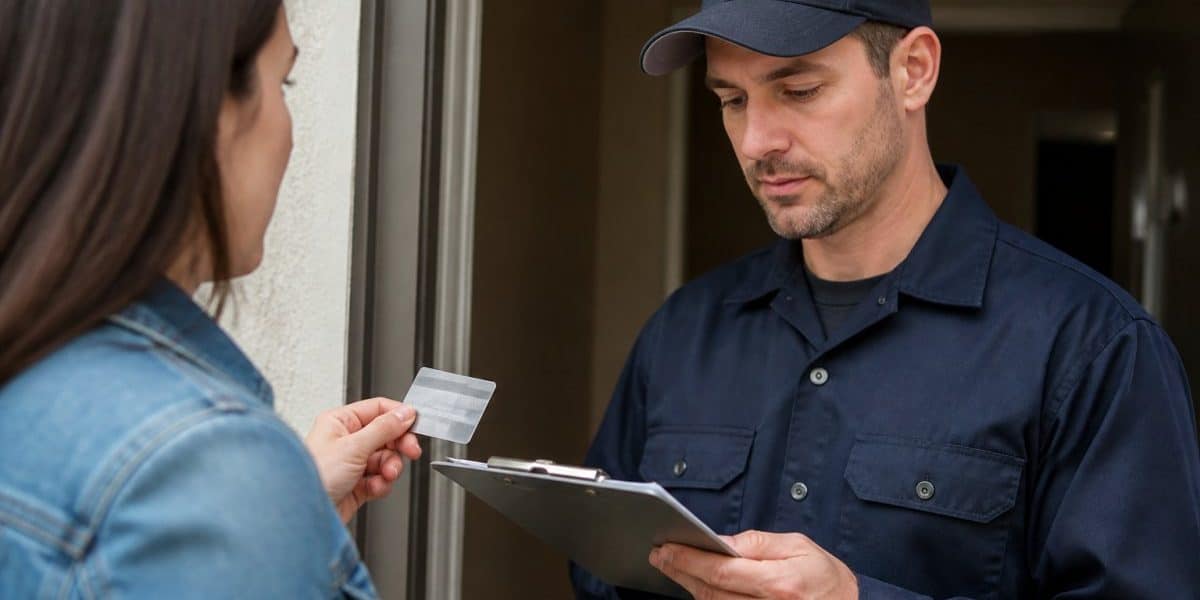
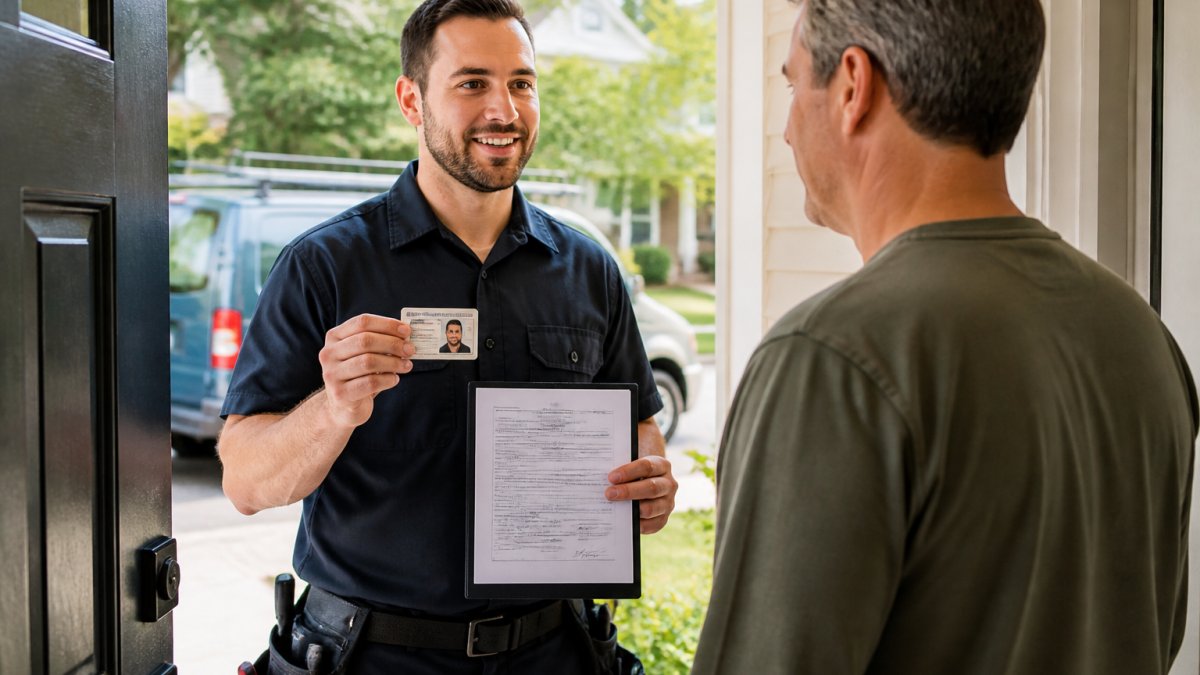
- Refusing to show ID: A legitimate locksmith carries identification and is happy to show it
If something feels off, hang up and call someone else.
What to Do If a Locksmith Cannot Verify Credentials
If a locksmith can’t or won’t verify their credentials, do not hire them. Period. Instead, ask for references and call them yourself, request a written quote before they arrive, ask to see their license and insurance in person before work starts, get everything in writing including the final price, pay by card so you have a record, and report unlicensed locksmiths to your state licensing board.
State-by-State Licensing Requirements and Lookup Resources
Locksmith licensing is not uniform. A handful of states require a statewide license, several regulate through local or county permits, and the rest impose no locksmith-specific credential at all. That patchwork is why no single national lookup tool exists, know which category your state falls into before searching.
States With Statewide Locksmith Licensing
A small number of states issue a dedicated locksmith license through a professional licensing board with a public lookup searchable by name or license number.
On the lookup page, confirm four fields: the licensee’s full name, license number, status (active, expired, suspended, or revoked), and expiration date.
States That Regulate Through Local Permits
Some states don’t issue a statewide locksmith license but allow cities and counties to require a local permit or business license.
A practical shortcut: call the non-emergency police line in the locksmith’s jurisdiction and ask whether the department maintains a locksmith permit list. Many do, and the desk officer can confirm a permit number in a minute or two.
States With No Locksmith-Specific Licensing
In the remaining states, there is no locksmith-specific license to verify. That doesn’t mean the locksmith is unaccountable, verification shifts to general business safeguards: state business registration through the Secretary of State, a local business license, liability insurance, and bonding.
If a locksmith in an unlicensed state claims to hold a “state locksmith license,” ask for the license number and the issuing agency. A legitimate claim can be verified in minutes. A vague answer is a red flag.
How to Find Your State’s Regulator in Under Five Minutes
Use this sequence when you don’t know which agency handles locksmith licensing in your state:
- Search your state’s Secretary of State website for “professional licensing” or “occupational licensing.”
- If locksmiths aren’t listed, call the state Department of Consumer Affairs and ask which agency, if any, regulates locksmiths.
- If the state has no locksmith board, ask for the local business licensing office in the locksmith’s city or county.
- Record the agency name, lookup URL, and date you checked, you’ll want that record if a dispute arises.
State professional licensing board directory
A common pattern among consumers who get burned: they checked a license in the wrong state. The call center was in one state, the technician dispatched from another, and the license belonged to neither. Verify the license in the state where the work will actually be performed, not the state on the caller ID.
Your Verification Checklist Before Work Begins
Before a locksmith arrives, run through this checklist. It takes 10 minutes and protects you.
| Step | What to Check | How to Verify |
|---|---|---|
| 1. License | Is the locksmith licensed in your state? | Search your state’s licensing database by name or number |
| 2. License Status | Is the license active and current? | Confirm “Active” status and check expiration date |
| 3. Disciplinary History | Has the locksmith been disciplined? | Ask the licensing board for complaint history |
| 4. Certification | Do they hold any professional certifications? | |
| 5. Insurance | Do they carry liability insurance? | Ask for proof and verify with the insurance company |
| 6. Bonding | Are they bonded? | Get bonding company name and policy number, verify it |
| 7. Business Registration | Is their business registered with the state? | Search your state’s Secretary of State database |
| 8. Reviews | What do past customers say? | Check Google, Yelp, and BBB ratings |
| 9. ID | Can they show valid identification? | Ask to see it before work begins |
| 10. Written Quote | Do you have a price quote in writing? | Get it in writing before they start work |
Print this checklist and keep it on your phone. Use it every time you hire a locksmith.
Frequently Asked Questions
How can I verify a locksmith is licensed?
Visit your state’s licensing board website and search by the locksmith’s name or license number. Most states maintain public databases where you can confirm the license is active and not expired. Ask the locksmith for their license number before hiring, and verify it matches their business name. If they cannot provide a number or the database shows no match, do not hire them.
What’s the difference between a locksmith license and a certification?
A license is required by law in many states and proves the locksmith meets minimum training and legal requirements set by state regulators. A certification is a voluntary credential from professional associations like the Associated Locksmiths of America (ALOA) that demonstrates advanced skills and expertise. A licensed locksmith may not be certified, and vice versa. Both are valuable, but a license is the legal baseline.
Should I ask a locksmith for proof of insurance?
Yes. Request proof of general liability insurance and, for automotive work, bonding. Insurance protects you if the locksmith damages your property. Ask them to provide a certificate of insurance with their company name listed. Verify the policy is current and covers locksmith services. If they refuse or cannot provide proof, that’s a major red flag.
What should I do if a locksmith cannot verify their credentials?
Do not hire them. An unlicensed or unverifiable locksmith puts your security and property at risk. If you need emergency help, contact your local police non-emergency line for a referral to a licensed professional, or call a company with a verifiable business address and license. Report unlicensed locksmiths to your state’s licensing board or attorney general.
Finding a trustworthy locksmith starts with knowing how to verify locksmith credentials. You’ve now got the tools to check licenses, spot fraud, and ask the right questions. When you’re ready to hire, Finest Locksmith LLC is here to help. Our team is licensed, insured, bonded, and ready to assist with residential, commercial, and automotive locksmith needs. We maintain the highest professional standards and stand behind our work. Call now for fast, reliable service you can trust.