

Quick Summary
Locksmith services for property managers are usually worth it when you handle frequent tenant turnover, multiple buildings, or unpredictable lockouts. Scheduled rekeying between tenants, reliable lockout response, and common-area hardware help cover most portfolios, while master key systems and access control suit larger properties.
- Book rekeying for the day of move-out or the day before move-in.
- Collect every key the previous tenant returned and match the count to your records.
- Replace a lock only when hardware is damaged or worn beyond what rekeying can fix.
- Keep a written record of which keys open which doors and who holds them.
- Request response-time commitments in writing, including after-hours and weekend coverage.
Table of Contents
- Which Locksmith Services Property Managers Actually Need
- Property Management Rekeying Services Between Tenant Turnovers
- Master Key Systems for Property Management
- Commercial Access Control Installation for Office and Mixed-Use Buildings
- Tenant Lockout Locksmith Services and Response Time Expectations
- Comparing Locksmith Providers: Pricing, Service Agreements and Vendor Onboarding
- Booking Your Property’s Locksmith Partner
- Frequently Asked Questions
Last Updated: November 4, 2026
Finest Locksmith LLC serves the Greater Boston area, and property managers often ask what a locksmith partner should actually do for them. Locksmith services for property managers cover rekeying between tenants, master key systems, access control for shared buildings, and fast lockout response. Whether these services are worth the cost depends on how many units you manage, how often tenants turn over, and how quickly you need access restored when something goes wrong.
Below, we cover each service, the situations where it pays off, and how to compare providers before you sign on. Most property managers do not need every service on this list, so the goal is to match the work to your portfolio.
Which Locksmith Services Property Managers Actually Need
Most property managers need three things from a locksmith: fast rekeying between tenants, reliable lockout response, and help with common-area hardware. Larger portfolios add master key systems and access control. Start by listing your turnover rate, the number of buildings you manage, and any units or areas where you need after-hours access.
For property managers, the most useful service is often a scheduled rekeying arrangement rather than one-off calls. Ask any provider whether they can schedule work around move-out and move-in dates.
Property Management Rekeying Services Between Tenant Turnovers
Rekeying replaces the internal pins in a lock so that old keys stop working, without replacing the entire lock.

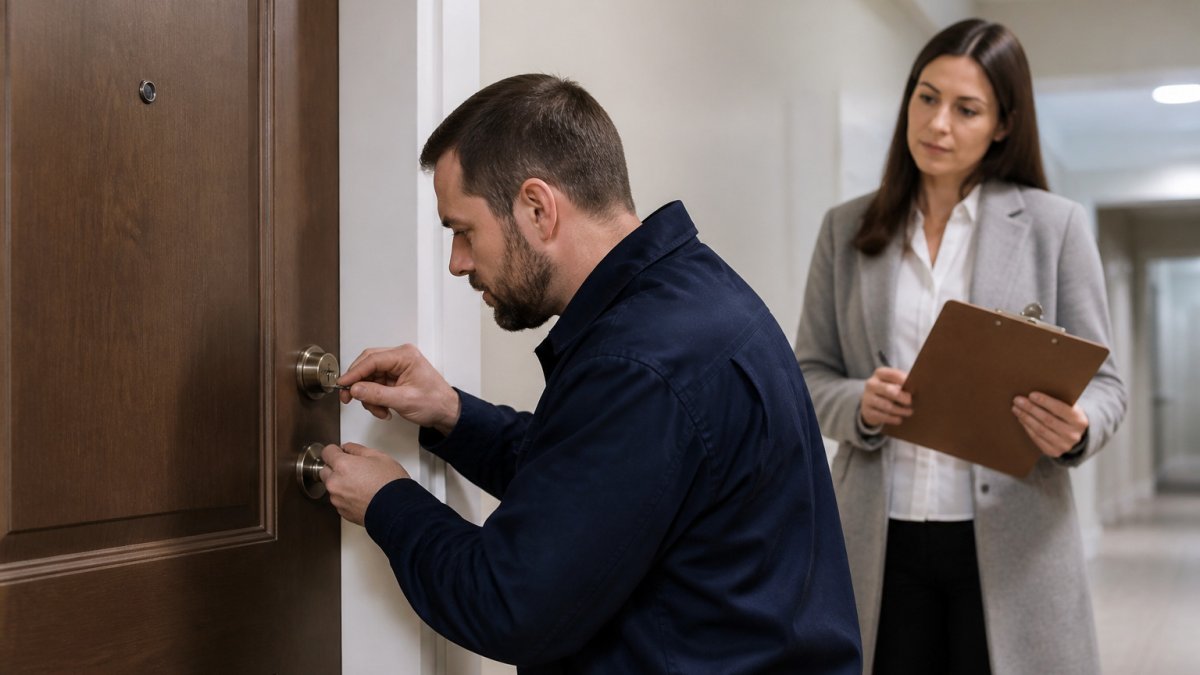
A common mistake is waiting until the new tenant is waiting at the door to schedule rekeying. Book the service for the day of move-out or the day before move-in, and collect every key the previous tenant returned.
Rekeying also makes sense whenever keys go missing, even if the tenant did not move out. Replace the lock outright only when the hardware is damaged or worn beyond what rekeying can fix.
The steps below summarise how to handle rekeying around a tenant turnover.
| Step | What to do | Timing |
|---|---|---|
| Book rekeying | Schedule the service for move-out or the day before move-in | Move-out or day before move-in |
| Collect keys | Gather every key the previous tenant returned | At move-out |
| Confirm key count | Match the total keys cut for each unit to your records | At rekeying |
| Decide replacement | Replace the lock only if hardware is damaged or worn | When damage is found |
Master Key Systems for Property Management
A master key system lets one key open every unit in a building, while each individual unit keeps its own key. Property managers use these systems so maintenance staff and emergency responders can access units without carrying dozens of keys.
Decide in advance which keys open which doors: unit keys, building-wide master keys, and possibly a grand master key that opens everything. Each added layer makes the system more complex to manage and more expensive to change, so plan the hierarchy before the locks are installed.
Keep a written record of every key issued and to whom. Without that record, a master key system can turn into a security problem instead of a convenience.
Commercial Access Control Installation for Office and Mixed-Use Buildings
Access control replaces or supplements traditional keys with credentials such as keycards, fobs, PIN codes, mobile credentials, or fingerprint readers. For mixed-use buildings with offices, retail, and residential units, the operational value is not the hardware itself, it is the ability to grant and revoke entry without rekeying every door each time a tenant or employee leaves. That distinction is where most property managers get tripped up, because a system that is easy to install can be hard to administer over a multi-year lifecycle.
Standalone smart locks vs. integrated access control
Standalone smart locks are the lowest-friction option: each lock manages its own credentials, often through a phone app, and there is no central server or software subscription. They suit small buildings, individual unit entries, and short-term or furnished rentals where the property manager needs remote code changes between guests.
Integrated access control uses a central controller and software to manage credentials across many doors. It costs more up front and requires network connectivity, a management console, and someone to administer it, but it gives you a single audit trail, bulk credential revocation, and scheduling by door and by user group.
Credential lifecycle and audit trails
Ask any provider to explain the full credential lifecycle before you sign: how a credential is issued, how it is suspended or revoked, how lost credentials are replaced, and how the system logs who entered which door and when. Confirm whether the property manager can revoke a credential without a site visit and whether the audit log is exportable for incident review. A system without an accessible audit trail turns every access dispute into a guessing game.
Watch out: a low per-door installation quote can hide recurring software subscription fees, cellular or network connectivity costs, and per-credential charges. Ask for a three-year total cost of ownership, not just the install price.
Connectivity, maintenance, and replacement planning
Access-control hardware has a lifecycle. Controllers, readers, and power supplies fail or become unsupported, and software platforms release updates that may not run on older hardware. Ask the provider how firmware updates are handled, what the warranty period is, and whether replacement parts will be available for the expected service life of the system. For networked systems, confirm whether the building has adequate connectivity at each controlled door and who is responsible for network troubleshooting when a reader goes offline.
Plan for replacement before the system fails.
Integration with existing property systems
Many property managers already run property management software, work-order systems, or building-automation platforms. Ask whether the access-control platform offers an API or integrations with those systems, and whether credential changes can be triggered by a move-in or move-out event rather than entered manually. Integration reduces administrative work and the risk of a credential remaining active after a tenant leaves. If integration is not available, confirm the manual process and who owns it. When integrations are unavailable, key tracking systems can still help centralize credential records and clarify who is responsible for updating them.
What to confirm in the quote
Ask for the quote to separate hardware, installation labor, programming, training, software subscription, and any connectivity costs. Confirm whether the price includes credential programming for the initial tenant roster, training for property staff, and a defined support period after installation. For mixed-use buildings, confirm that the system can enforce different access rules for office, retail, and residential areas without requiring separate systems.
Tenant Lockout Locksmith Services and Response Time Expectations
Tenant lockouts are the most frequent emergency call property managers receive. Before you sign with a provider, confirm three things: the response time they commit to, whether service runs around the clock, and how the price is quoted.
Ask for response-time expectations in writing, and check whether they apply after hours and on weekends.
Keep a record of each lockout: date, unit, reason, and whether the tenant was charged. This helps you spot patterns, such as repeat lockouts that suggest a tenant needs a key replacement or a lock that needs service.
Comparing Locksmith Providers: Pricing, Service Agreements and Vendor Onboarding
Most locksmith landing pages stop at “call us for a quote.” Property managers need more: a written service-level agreement (SLA), a pricing structure they can budget against across multiple buildings, and an onboarding process that verifies licensing and insurance before the first work order. Use the criteria below to compare providers on the things that actually affect portfolio operations.
Service-level agreements and response windows
Ask every provider to put response expectations in writing. A useful SLA separates emergency lockouts from scheduled work and states a target arrival window for each, plus what happens after hours and on weekends. Confirm whether the provider charges a trip fee when a tenant is not home or the unit is already unlocked, and whether that fee is waived on a repeat visit.
Watch out: a verbal promise of “fast response” is not an SLA. If the provider will not state a window and an escalation contact in writing, treat the response time as unknown when you compare bids.
Pricing mechanics and portfolio-level cost planning
Locksmith pricing usually breaks into three buckets: scheduled work (rekeys, lock installs, hardware replacement), emergency work (lockouts, after-hours calls), and project work (master key systems, access control). Ask for each bucket to be quoted separately so you can compare providers line by line.
Budget planning is easier when you separate recurring costs (scheduled rekeys tied to turnover) from unpredictable costs (lockouts and damage). That gives you an apples-to-apples comparison and a defensible annual budget line.
Credential control and audit trails
Keys and credentials are the part of locksmith work that most often goes wrong after the technician leaves. Ask how the provider documents every key cut, who receives it, and how keys are returned or revoked at move-out. For access-control systems, confirm whether the platform keeps an audit log of credential use and administrative changes, and whether the property manager can revoke a credential without a site visit.
Compliance, accessibility, and fire-safety considerations
Lock and hardware changes can affect egress and accessibility. Before approving hardware swaps on common doors or unit entries, confirm the change does not interfere with panic hardware, exit devices, or accessibility requirements for the building. This is not legal advice; confirm requirements with your local authority having jurisdiction and your building’s life-safety consultant.
Vendor selection and onboarding checklist
Use this checklist to verify a provider before adding them to your vendor list:
- Current state locksmith license, if your state requires one, and proof of general liability insurance with limits that match your property’s requirements
- Written SLA with emergency and scheduled response windows, after-hours coverage, and an escalation contact
- Itemized quote structure for scheduled, emergency, and project work, plus volume or maintenance-agreement terms
- Key-control and credential-revocation procedure, including audit-log access for access-control systems
- References from other property managers with similar building types and unit counts
- Certificate of insurance naming your ownership entity or management company as additional insured, where required
- A named account contact and a work-order intake process that fits your existing maintenance workflow
A practical test is to request two sample quotes, one for a single-unit rekey and one for an after-hours lockout, and ask how each would be invoiced. The answers reveal how transparent the provider is before you commit to a portfolio-wide arrangement.
Booking Your Property’s Locksmith Partner
Start by listing your buildings, unit counts, average turnover rate, and any after-hours access needs. Use that list to decide which services to set up first.
Finest Locksmith LLC serves the Greater Boston area with residential, commercial, and automotive locksmith work, and is located in the Watertown Mall in front of the RMV. Contact us to discuss your portfolio, request a written quote, or book a scheduled rekeying service. Call now to set up emergency coverage before you need it.
Frequently Asked Questions
Should property managers rekey or replace locks between tenants?
Rekeying is usually the faster and lower-cost choice when the lock hardware is in good condition, because the technician changes the internal pins so old keys stop working while the lock itself stays in place. Replacement makes more sense when a lock is damaged, worn, or outdated, or when the previous tenant had a key you cannot account for. Final pricing depends on the number of locks, the hardware type, and the service visit, so request a written quote from Finest Locksmith LLC before scheduling.
What does a commercial locksmith do for property managers?
Finest Locksmith LLC provides residential, commercial, and automotive locksmith services in the Greater Boston area, and current pricing is available by contacting the company directly.
How quickly can a locksmith respond to a property lockout?
Response time depends on the provider’s dispatch capacity, location, and the time of day. Ask any locksmith for a stated response-time target in writing, and confirm whether it applies to nights and weekends as well as business hours. Finest Locksmith LLC advertises 24/7 emergency lockout assistance and fast arrival, and it lists a flat price for emergency services. Ask for the arrival window and the emergency rate when you call, so your tenant knows what to expect before the technician arrives.

