
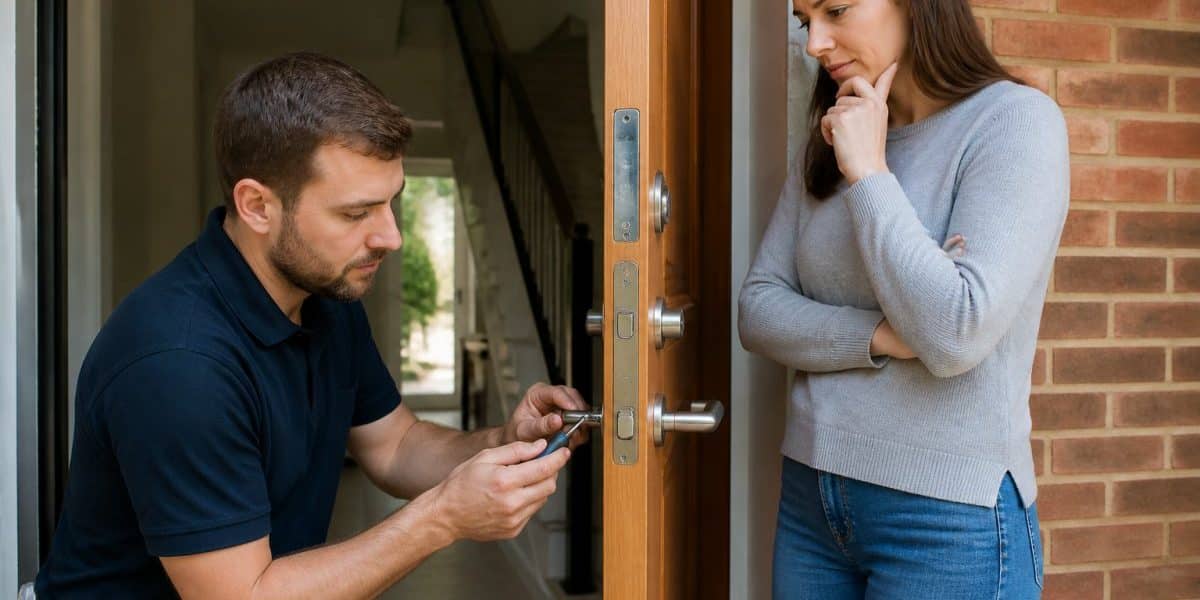
Table of Contents
- What Is Flat Rate Locksmith Pricing?
- Benefits of Flat Rate vs. Hourly Pricing
- Understanding the Average Locksmith Service Call Fee
- How to Avoid Locksmith Scams and Bait-and-Switch Tactics
- Step 1: Verify the license before the technician arrives
- Step 2: Confirm insurance, not just a claim of it
- Step 3: Confirm a physical address and a real phone number
- Step 4: Get the all-in price in writing before work starts
- Step 5: Never pay cash upfront, and never pay before the work is verified
- Step 6: Watch for subcontractor red flags
- Step 7: Research before you are locked out
- Commercial Locksmith Service Rates and Flat Pricing
- Emergency vs. Scheduled Service: How Pricing Differs
- What to Ask Before Hiring a Locksmith
- Frequently Asked Questions
Last Updated: October 7, 2026
What Is Flat Rate Locksmith Pricing?
Flat rate locksmith pricing is a transparent fee structure where you pay a fixed price for a specific service, regardless of how long the job takes.
You know exactly what you’ll pay before the technician arrives: a rekey, emergency lockout, or deadbolt installation each has its own flat rate, so whether the job takes 20 minutes or an hour, your cost stays the same.
At Finest Locksmith LLC, our flat rate pricing for emergency services means no surprises when you’re locked out at 2 AM, just immediate response, fast arrival time, and no hidden fees.
Benefits of Flat Rate vs. Hourly Pricing
Flat rate pricing solves the uncertainty hourly billing creates: with hourly billing, a slow technician or a difficult lock compounds the expense.
With flat rate locksmith pricing, that pressure disappears.
Budget predictability: if your lock fails at midnight, your wallet won’t suffer another shock when the invoice arrives.
No incentive to rush. Hourly locksmiths rush to the next call; flat rate pricing lets technicians focus on doing the job right.
Transparency builds trust. Your quote breaks down the service call fee, labor, hardware markup, and other charges.
Understanding the Average Locksmith Service Call Fee
A service call fee, also called a trip fee or dispatch fee, covers travel time, fuel, vehicle wear, and the opportunity cost of reserving a slot.
Labor is separate: the time and skill applied to the job, picking a cylinder, drilling a deadbolt, rekeying a pin tumbler, programming a transponder key.
Here is how the components typically stack up on a residential job:
- Trip fee: a flat dispatch charge, usually the same whether you are five minutes or twenty minutes from the technician.
- Labor: the skill-based portion, lockout entry, rekey, cylinder replacement, or installation.
- Hardware: the physical lock, cylinder, key blank, or smart lock being installed. This is passed through with a markup, typically 20-50% over the technician’s wholesale cost.
- After-hours premium: a multiplier applied to the trip fee and sometimes the labor for nights, weekends, and holidays.
That last component is where most billing disputes start: a base trip fee often roughly doubles for after-hours dispatch. Some companies fold the premium into a single flat emergency rate; others itemize it.
Why the trip fee and labor get conflated
Bait-and-switch operations rely on this confusion. They advertise a low trip fee, sometimes under $20, and let you assume that is the total. When the technician arrives, the trip fee is honored, then labor and hardware are added at inflated rates, leaving the customer feeling deceived even though every charge was disclosed.
The defense is to ask for the all-in number, not the trip fee. A legitimate flat-rate locksmith will quote one figure that already includes dispatch, labor, and standard hardware. If a company will only quote the trip fee over the phone, that is the tell.
How hardware quality moves the flat-rate quote
Hardware is the component most customers overlook, and the one that swings a flat-rate quote the most: a builder-grade knob cylinder and a high-security deadbolt are not the same product.
- Builder-grade entry lockset: cheapest option, common on new construction. Fast rekey and low flat rate, but minimal pick and bump resistance.
- Mid-grade deadbolt (ANSI Grade 2): the standard residential upgrade, higher pick resistance, better strike plate, and a flat rate reflecting extra installation time.
- High-security cylinder (ANSI Grade 1 or restricted keyway): top of the residential range. Restricted keyways require keys cut on-site or ordered, adding to the flat rate, and resist picking, bumping, and unauthorized duplication.
- Smart locks and electronic deadbolts: flat rate includes pairing, app setup, and often a return visit for firmware or hub issues. Expect the highest residential flat rate here.
When comparing two flat-rate quotes for the same job, compare the hardware spec, not just the number. A $40 difference on a rekey often means one quote includes a Grade 2 cylinder and the other is reusing a builder-grade one.
Ask the locksmith to name the hardware brand and ANSI grade before you approve the flat rate. A professional will answer immediately. A vague answer, “it’s a standard lock”, is a signal to get a second quote.
Understanding these components lets you evaluate a quote instead of just accepting it. A legitimate locksmith itemizes trip fee, labor, hardware, and specialty charges.
How to Avoid Locksmith Scams and Bait-and-Switch Tactics
The bait-and-switch is the most common locksmith scam: a company quotes an absurdly low price over the phone, then the technician arrives, claims the job is more complex than described, and demands more money.
You are locked out, stressed, and desperate. They know it. That is when the real price appears.
Most articles stop at “get a written estimate.” That advice is correct but incomplete.
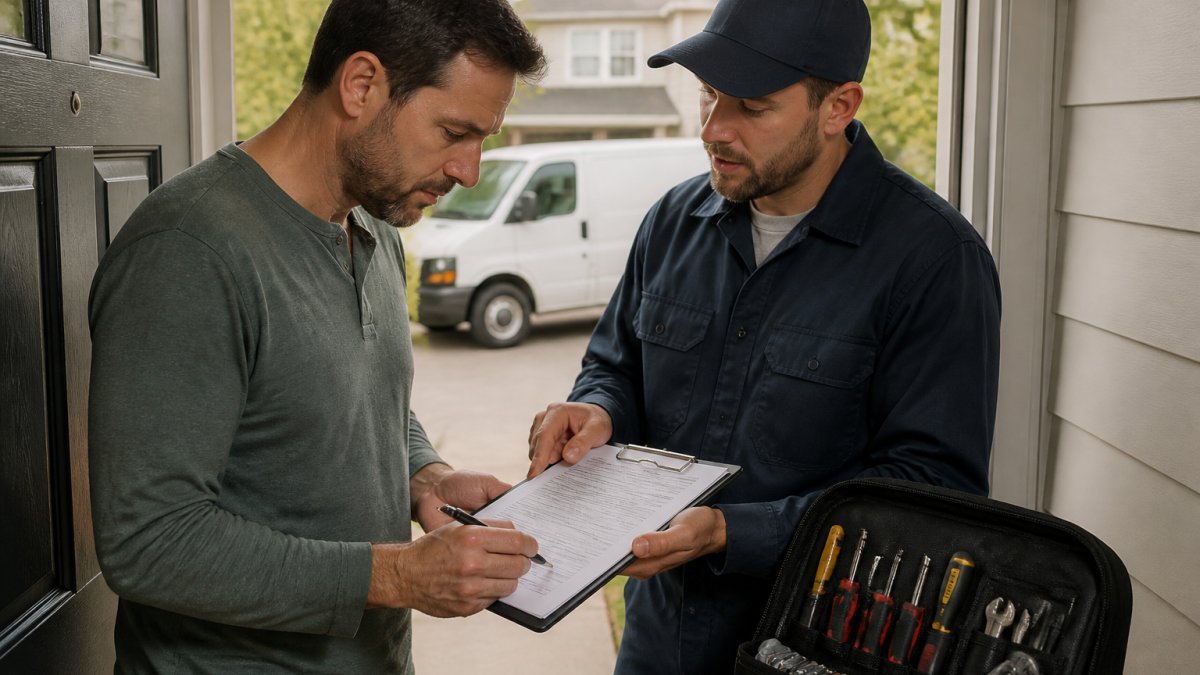
Step 1: Verify the license before the technician arrives
Locksmith licensing is state-by-state: some states require a license, some a registration, and some have no statewide requirement.
- Ask for the license number over the phone, before dispatch. A legitimate company has it ready.
- Look up the number in your state’s licensing database.
- Confirm the name on the license matches the company that quoted you, not just the technician’s name.
- If your state has no licensing requirement, ask for a business license or contractor registration instead. A real business has one.
A technician who cannot produce a license number, or whose number does not match the company name, is a stop-work signal. Do not let them begin.
Step 2: Confirm insurance, not just a claim of it
“Fully insured” is a phrase, not proof. Ask the dispatcher to email a certificate of insurance (COI) showing general liability coverage before the technician arrives, a legitimate company can produce one in minutes.
If a technician damages your door frame, breaks a window, or scratches a finished surface, general liability coverage pays for the repair. Without it, you are chasing an uninsured individual for damages.
A technician who says “we’re insured” but cannot produce a certificate is not verified. Insurance claims are easy to make and hard to disprove at the door. Ask for the document.
Step 3: Confirm a physical address and a real phone number
Scam operations frequently run from a call center with no local presence, dispatching technicians from a rotating pool with no physical location you could visit.
- Search the company name plus “address” and confirm a street address exists.
- Call the main line, not the number from the ad, and ask for the address. If the person who answers cannot give one, that is a red flag.
- Check the address on a mapping service. A residential house or a virtual office is not a locksmith shop.
- Cross-check the business on the Better Business Bureau and your state’s Secretary of State business registry.
Step 4: Get the all-in price in writing before work starts
A written estimate should list every charge: trip fee, labor, hardware, and specialty fees. For flat-rate locksmith pricing, the quote should be fixed unless the scope changes dramatically. If a damaged lock costs extra, get that number in writing too.
The specific question to ask is: “What is the total I will pay, all in, for this job as described?” If the answer is a range, a trip fee only, or “we’ll see when we get there,” you are being set up for a bait-and-switch.
Step 5: Never pay cash upfront, and never pay before the work is verified
Pay after the work is complete and you have tested it. Demanding payment before starting is a scam signal; legitimate professionals collect once you have verified the work.
Also watch for these payment red flags:
- Cash-only, no receipt.
- Payment by peer-to-peer app to a personal account rather than a business account.
- Pressure to pay before the technician leaves the driveway.
- A demand for a tip or “convenience fee” not in the original quote.
Step 6: Watch for subcontractor red flags
Some locksmiths send subcontractors instead of their own technicians. Not always bad, but it matters: a subcontractor may not be bound by the quoted price or held to the same standards.
Ask directly: “Will you be doing the work, or sending someone else?” If the answer is a subcontractor, ask for that person’s license and insurance before they start. If the company cannot provide it, cancel.
Step 7: Research before you are locked out
The best time to verify a locksmith is before you need one. Save a trusted company’s number in your phone and check reviews on Google and the Better Business Bureau, looking for a pattern of pricing complaints rather than a single bad review.
A company with a physical address, a verifiable license, a certificate of insurance, and a written flat-rate quote is one you can trust at the door. A company that cannot produce any of those is not.
Commercial Locksmith Service Rates and Flat Pricing
Commercial properties have different security needs than homes.
Commercial locksmith service rates reflect this complexity: you might be securing 50 entry points, installing new deadbolts, and setting up a master key system so authorized personnel can access multiple areas.
Flat rate locksmith pricing works well for commercial jobs because it accounts for scope upfront.
Finest Locksmith LLC handles both residential locks and small office building security, with experienced technicians who ensure your facility meets required code standards while staying within budget.
Emergency vs. Scheduled Service: How Pricing Differs
Emergency lockout service costs more than scheduled work, reflecting real differences in how locksmiths operate.
Scheduled service happens during business hours, when the locksmith can plan the day, stack jobs geographically, and work efficiently.
Night and weekend surcharges are standard: many locksmiths charge 50-100% more for after-hours calls, while some charge flat rates with the emergency premium built in.
Emergency response time is part of what you’re paying for: a guaranteed 20-minute arrival means committing resources to be ready, and that reliability costs money.
Finest Locksmith LLC offers 24/7 emergency lockout service.
What to Ask Before Hiring a Locksmith
Before you hire any locksmith, ask these questions.
“Are you licensed and insured?” A legitimate locksmith carries both.
“How long have you been in business?” Experience matters.
“Will you be doing the work personally?” Some locksmiths send subcontractors.
“Can you provide references?” Ask for contact information from recent clients.
“Do you have a physical location?” Scam operations often work from phone lines only.
A technician who answers clearly and provides written documentation is someone you can trust.
Finding a locksmith you can trust starts with understanding how pricing works.
When you need locksmith services, look for professionals who prioritize price transparency and upfront communication.
Frequently Asked Questions
What are the primary benefits of flat rate locksmith pricing?
Flat rate locksmith pricing eliminates uncertainty by setting a single price upfront for your service. You avoid surprise charges for labor, trip fees, or hardware markups that can accumulate with hourly billing. This model protects you from bait-and-switch tactics where a low initial quote climbs dramatically once the technician arrives. Flat rates also reward efficiency, a skilled locksmith can complete your deadbolt installation or emergency lockout service faster without your cost increasing, and the technician has no incentive to slow down the job.
How does flat rate pricing protect customers from hidden fees?
The quote includes all labor costs, service call fees, and hardware charges in one number. With hourly rates, technicians often add unexpected charges for on-site evaluation, lock manipulation, rekeying, or specialized tools. A flat rate eliminates this guesswork. Always confirm the quote covers everything before the technician begins work.
Is flat rate locksmith pricing more cost-effective than hourly rates?
Flat rate pricing is typically more cost-effective for standard jobs like emergency lockouts, key duplication, and deadbolt installation. Hourly rates can escalate quickly if the technician encounters complications or spends time on-site evaluation and lock manipulation. Flat rates reward speed and expertise, an experienced technician completes your job faster without your bill rising. However, highly complex commercial projects with custom access control or extensive rekeying may sometimes be priced differently. Always request a service estimate before committing, and compare upfront pricing from multiple professional locksmiths to ensure you’re getting fair value.
What questions should I ask a locksmith before hiring them?
Ask whether they offer upfront, fixed pricing and confirm the quote includes all labor, service call fees, and hardware. Ask about their response time for emergency service. Request details on their experience with your specific need, residential locks, commercial access control, or automotive key programming. Ask if they’re available 24/7 if you need night service or weekend surcharge availability. Finally, ask about their billing transparency policy to avoid surprises.