
Table of Contents
- Locksmith vs Dealership Key Replacement: Which Option Wins
- Cost of Car Key Replacement: Locksmith Pricing vs Dealership Fees
- Turnaround Time and Convenience: Mobile Service vs Shop Visits
- Transponder Key Programming Cost and Technical Requirements
- Mobile Automotive Locksmith Services: When to Choose On-Site Help
- OEM Parts, Aftermarket Keys, and Warranty Considerations
- Insurance and Roadside Assistance: Coverage That Matters
- Conclusion
- Frequently Asked Questions
Last Updated: October 2, 2026
Locksmith vs Dealership Key Replacement: Which Option Wins
When your car key goes missing or stops working, you face a critical choice in locksmith vs dealership key replacement: call an automotive locksmith or head to the dealership. Both options can get you back on the road, but they differ dramatically in cost, speed, and convenience. Understanding these differences helps you make the right call for your situation.
Cost of Car Key Replacement: Locksmith Pricing vs Dealership Fees
Locksmith services typically cost less than dealership replacements, but the final price depends on your vehicle and key type.
Dealerships charge premium rates because they’re factory-authorized with proprietary diagnostic tools. For basic key replacement, expect to pay more than an independent locksmith.
Automotive locksmiths offer the same service at lower cost with aftermarket keys and flat-rate emergency fees, providing transparency that appeals to customers wary of hidden charges.
However, pricing varies significantly based on:
- Vehicle year and model. Newer vehicles with advanced security systems cost more to replace keys for, regardless of whether you use a locksmith or dealership.
- Key type. Transponder keys, smart keys, and laser-cut keys all command different prices.
- Time of service. After-hours or emergency locksmith calls may include surcharges, while dealership pricing is consistent during business hours.
- Your location. Urban areas typically have more competitive locksmith pricing than rural regions.
For a straightforward key replacement on a common vehicle model, a locksmith visit often saves several hundred dollars compared to the dealership. But for rare vehicles or advanced security systems, the gap narrows.
Turnaround Time and Convenience: Mobile Service vs Shop Visits
Mobile locksmith services arrive at your location, while dealerships require you to bring your vehicle to them.
This difference alone changes everything for many vehicle owners. If you’re locked out in a parking lot or stranded at home, waiting for a dealership appointment isn’t practical. An automotive locksmith can typically arrive within 30-60 minutes for emergency calls. Finest Locksmith LLC prioritizes fast response times.
Dealerships operate on appointment schedules during business hours. If your key fails on a Saturday afternoon, you’re waiting until Monday, plus additional time at the dealership for service completion.
Mobile locksmiths eliminate the trip and can complete key replacement or programming on-site, benefiting business owners and busy professionals who can’t afford downtime.
The trade-off: dealership service is predictable and scheduled, while locksmith availability depends on local demand.
Transponder Key Programming Cost and Technical Requirements
Modern vehicles use transponder keys with embedded chips programmed to your vehicle’s immobilizer system. The method used to create and program that key varies significantly between locksmiths and dealerships.
VIN-Based Key Cutting vs. Physical Key Cloning
Dealerships and high-end locksmiths typically use VIN-based key cutting, which accesses your vehicle’s identification number through the manufacturer’s database or the vehicle’s onboard diagnostic system. This method:
- Retrieves the exact key code from factory records
- Programs a new transponder chip to match your vehicle’s immobilizer
- Works reliably for vehicles with complex security systems
- Costs more because it requires access to proprietary databases and factory-level diagnostic tools
Some locksmiths use physical key cloning, which involves:
- Copying an existing working key’s physical cuts and chip data
- Extracting the transponder code from your current key and transferring it to a new blank
- Requiring you to have at least one working key present
- Costing significantly less because it bypasses the need for database access
Physical cloning works well for older vehicles and standard key types, but it has a critical limitation: if your vehicle’s security system has been updated or if you’ve lost all keys, cloning won’t work. You’ll need VIN-based programming, which means a dealership visit or a locksmith with advanced diagnostic equipment.
Cost and Tool Differences
Dealerships have factory-level diagnostic tools and access to manufacturer databases, allowing them to program any transponder key using VIN-based methods. Experienced locksmiths can program many keys using aftermarket equipment like Autel or Launch scanners, but newer vehicles, particularly luxury brands and models from 2015 onward, have security restrictions that only dealership tools can bypass.
Dealership transponder key programming ranges from $150-$300, while locksmith physical cloning costs $75-$150. However, if your vehicle requires VIN-based programming and the locksmith lacks database access, you’ll need dealership service anyway.
When Each Method Works Best
Use a locksmith for physical cloning if:
- You have at least one working key to clone from
- Your vehicle is pre-2015 or uses standard transponder technology
- You need emergency service and cost is the priority
Go to the dealership or a locksmith with VIN-based capability if:
- You’ve lost all keys
- Your vehicle is 2015 or newer with advanced security
- Your vehicle is a luxury brand (BMW, Mercedes, Audi, Lexus, etc.)
- The locksmith cannot confirm they have database access to your vehicle’s manufacturer
Before calling a locksmith, ask directly: “Can you program my key using VIN-based access, or do you use physical cloning?” Their answer will tell you whether they can actually help or if you need dealership service.
Mobile Automotive Locksmith Services: When to Choose On-Site Help
Mobile locksmiths bring equipment directly to you, providing immediate help without transportation hassle. They respond quickly to emergencies like lockouts or broken keys at rest stops.
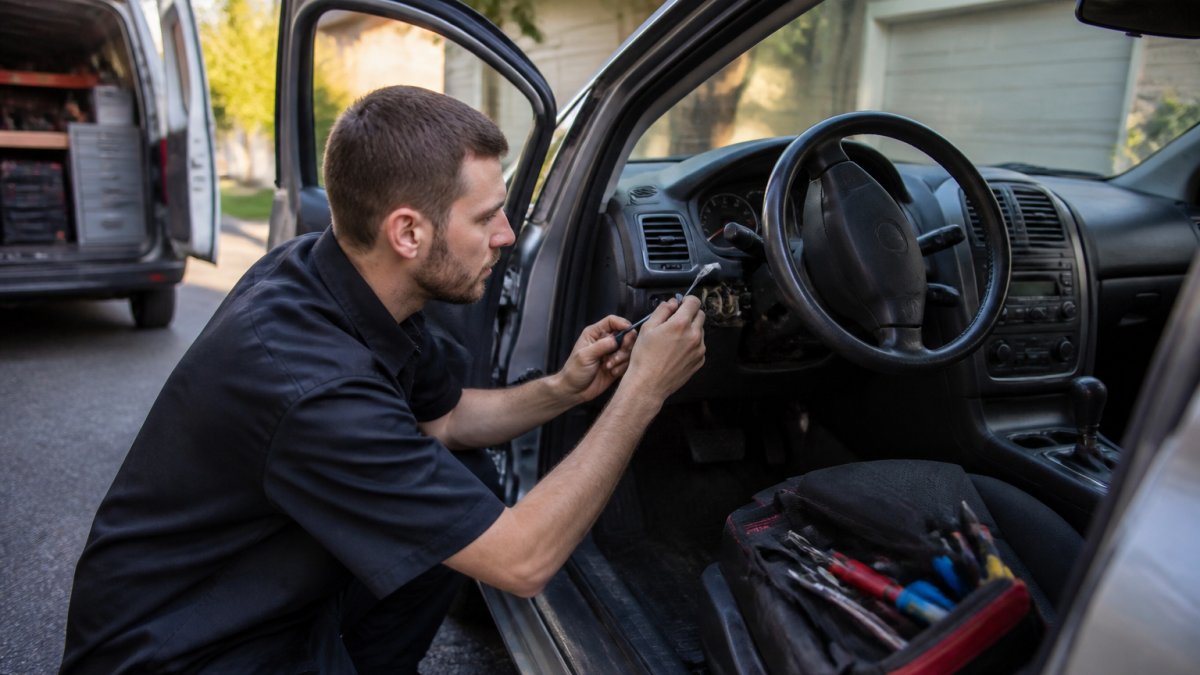
Mobile locksmiths excel at emergency situations and basic key replacement for vehicles without advanced security systems. However, if your vehicle requires factory-level programming or has security restrictions, you may need dealership service anyway.
The best approach: call a reputable mobile locksmith first. They’ll assess your situation and be honest about whether they can help. If they can’t, they’ll direct you to the dealership. This saves time compared to going straight to the dealership for every key issue.
OEM Parts, Aftermarket Keys, and Warranty Considerations
OEM parts come from the vehicle manufacturer, while aftermarket keys are produced by third parties. The choice affects not just cost and warranty, but also security and long-term reliability.
OEM vs. Aftermarket: What You’re Actually Buying
Dealerships use OEM parts exclusively. These keys are manufactured to exact factory specifications and are guaranteed to work with your vehicle. The trade-off is cost. OEM keys are expensive because they’re proprietary and factory-controlled.
Aftermarket keys are produced by independent manufacturers using the same cutting and programming standards. They function identically to OEM keys for most vehicles.
- Has a shorter lifespan before the transponder fails
- Uses lower-grade encryption that some security researchers have found easier to clone
- May not be programmed to the same tolerances as OEM chips, causing intermittent starting issues
- Lacks the same durability testing that OEM keys undergo
Security Risks of Cheap Aftermarket Fobs
This is where the “cheap vs. quality” debate becomes a security issue, not just a convenience one. Modern key fobs contain wireless receivers that communicate with your vehicle’s locking and ignition systems. Aftermarket fobs from unknown manufacturers may:
- Use weaker encryption protocols that are vulnerable to relay attacks (where a thief captures and rebroadcasts your fob’s signal)
- Lack rolling code technology, which changes the signal each time you press the button (OEM fobs use this; cheap aftermarket versions sometimes don’t)
- Have poor shielding that makes them susceptible to signal jamming
Warranty Implications
If you use an aftermarket key and later have security system problems, the dealership may deny warranty coverage if they determine the aftermarket key caused the issue. This is rare but possible. For vehicles still under manufacturer warranty, using dealership keys provides legal protection.
Making the Right Choice
| Comparison | OEM Keys | Quality Aftermarket Keys | Budget Aftermarket Keys |
|---|---|---|---|
| Cost | Higher ($150-$300) | Medium ($50-$100) | Low ($20-$40) |
| Compatibility | Factory guaranteed | High (from reputable suppliers) | Variable |
| Transponder lifespan | 7-10 years typical | 5-8 years typical | 2-4 years typical |
| Security features | Full encryption, rolling codes | Full encryption, rolling codes | May lack rolling codes |
| Warranty risk | None | Minimal (if key didn’t cause issue) | Possible |
| Availability | Dealership only | Locksmith or dealership | Online or discount locksmiths |
For older vehicles outside the warranty period: Aftermarket keys from an established locksmith present no real risk. You get the same functionality at a fraction of the cost, and reputable suppliers stand behind their products.
Insurance and Roadside Assistance: Coverage That Matters
Many vehicle owners overlook insurance and roadside assistance coverage that can dramatically reduce key replacement costs.
Conclusion
The locksmith vs dealership decision comes down to your specific situation. For emergencies, convenience, and cost savings on standard key replacements, an automotive locksmith is usually the better choice. For advanced security systems, warranty protection, or complex programming, the dealership may be necessary.
Frequently Asked Questions
Is it cheaper to go to a locksmith or dealer for key replacement?
Locksmiths typically cost less than dealerships for key replacement, especially for basic transponder keys and laser-cut keys. Dealerships charge higher labor rates and often require vehicle diagnostic scans. However, pricing depends on your vehicle model, key type, and whether you need emergency service. For an accurate quote, contact your local automotive locksmith or dealership directly with your vehicle’s VIN and key details.
Can a locksmith replace a car key if I have lost the original?
Yes, an automotive locksmith can replace a lost car key using VIN verification and key code lookup. They can cut new keys, program transponder chips, and reprogram key fobs without the original key. Dealerships can do the same, but locksmiths typically complete the process faster and at lower cost. Both require proof of vehicle ownership to ensure security.
How long does it take to get a new car key from a locksmith versus a dealer?
A mobile automotive locksmith can typically replace a key within 30 minutes to an hour on-site, making it faster for emergency situations. Dealerships usually require an appointment and may take several hours to days, especially if they need to order parts. Turnaround time depends on key complexity, vehicle availability, and whether the service is mobile or shop-based.
Are aftermarket keys from a locksmith as reliable as dealership keys?
Quality aftermarket keys from reputable locksmiths are reliable and function identically to OEM keys for most vehicles. However, some luxury or newer vehicle models have advanced security features that only OEM parts fully support. Aftermarket keys cost less but may lack certain features. Ask your locksmith whether OEM or aftermarket options are recommended for your specific vehicle model.